
For a long time now, I have become affiliated to Nigeria’s chronic irregularities. The patterns I’ve been observing over years remain constant: a systemic breakdown in regulatory oversight, porous borders, and a culture of impunity where economic interests consistently override environmental and social wellbeing. So, when Arise News1 reported that foreign nationals were illegally mining the mineral-rich lands of the country, my reaction was muted. The breakdown in governance, the exploitation of local landscapes, and the silence around accountability mirror exactly what Murray Bookchin described as the root of ecological collapse—social disorder. In other words, Nigeria’s mining crisis is not just about the land being stripped, but about the people who stripped it. And the crisis cannot be ignored because it exposes layers of governance and social failure that, in Murray BookChin’s perspective, underpins ecological collapse.
Illegal mining has once again taken center stage in Nigeria’s environmental conversations. Recent investigations by The Guardian Nigeria2 have uncovered hidden mining sites (many linked to foreign nationals) that have left communities bewildered, angry, and exhausted. You can feel the weight of the stories: villagers watching their farmlands ripped open, streams turning murky overnight, and forests carved into lifeless stretches of earth.
It is easy to frame this as just another environmental crisis. You might even choose to pay no heed. But when you look closer, the soil tells a deeper story, a story that mirrors Murray Bookchin’s idea of social ecology, i.e the belief that the way a society is built, governed, and organized will always reflect itself in the environment. At this juncture, it is important to add that, the discourse around social ecology is not without tension. Although Bookchin situates ecological harm within social hierarchy and political organization, the term social ecology itself has long been entangled with histories of colonial extraction—where “managing” nature was often used to justify domination of people and land. In the African context, environmental governance cannot be separated from the colonial legacies that shaped systems of resource control. Illegal mining in Nigeria today is therefore not just a social-ecological crisis but also an extension of extractive patterns rooted in colonial economic structures. Nevertheless, while these tensions are noteworthy to assert, focus remains on the substantive value of Bookchin’s theory. Particularly how its core claims illuminate the realities of contemporary Nigerian society.
Needless to add that in Nigeria, that illumination is becoming painfully clear. An eyesore in fact. A conspicuous one.
The Human Roots of an Ecological Crisis
Bookchin once argued that nature doesn’t destroy itself—people do, through the societies they create. Environmental collapse, according to him, is never separate from social collapse. They're somewhat entwined.
In Nigeria, those conditions are everywhere. Communities battling poverty, institutions struggling with credibility, foreign actors moving with boldness, and a general sense that some people and companies operate just above the law.
It becomes evident that the destruction we see in the bush is tied to the dysfunction we see in our systems. Simply put, this is a case study of how “patriotic” citizens use their hands to destroy their state.
The environment, in many ways, has become a canvas where our deepest societal fractures play out.

Ogoniland in Nigeria (Photo copied from Sustainable Development Goals: https://sdg.iisd.org/news/unep-releases-results-and-recommendations-of-ogoniland-oil-assessment/)
How the Land Mirrors the Society
Walk through an illegal mining site and you learn quickly that the environment remembers everything. The deep pits, the poisoned water, and the abandoned equipment are not just signs of illegal activity, they are reminders of broken trust and broken structures.
A polluted river doesn’t simply say “chemicals were poured here.” It says:
“People were not protected.”
Clocked. Clocked. Clocked.
A deforested land doesn’t just say “trees were cut.” It says:
“Communities were not heard.”
Clocked. Clocked. Clocked.
The scars on the landscape are reflections of the gaps in governance, the weight of poverty, and the imbalance of power between those who control resources and those who live with the consequences.
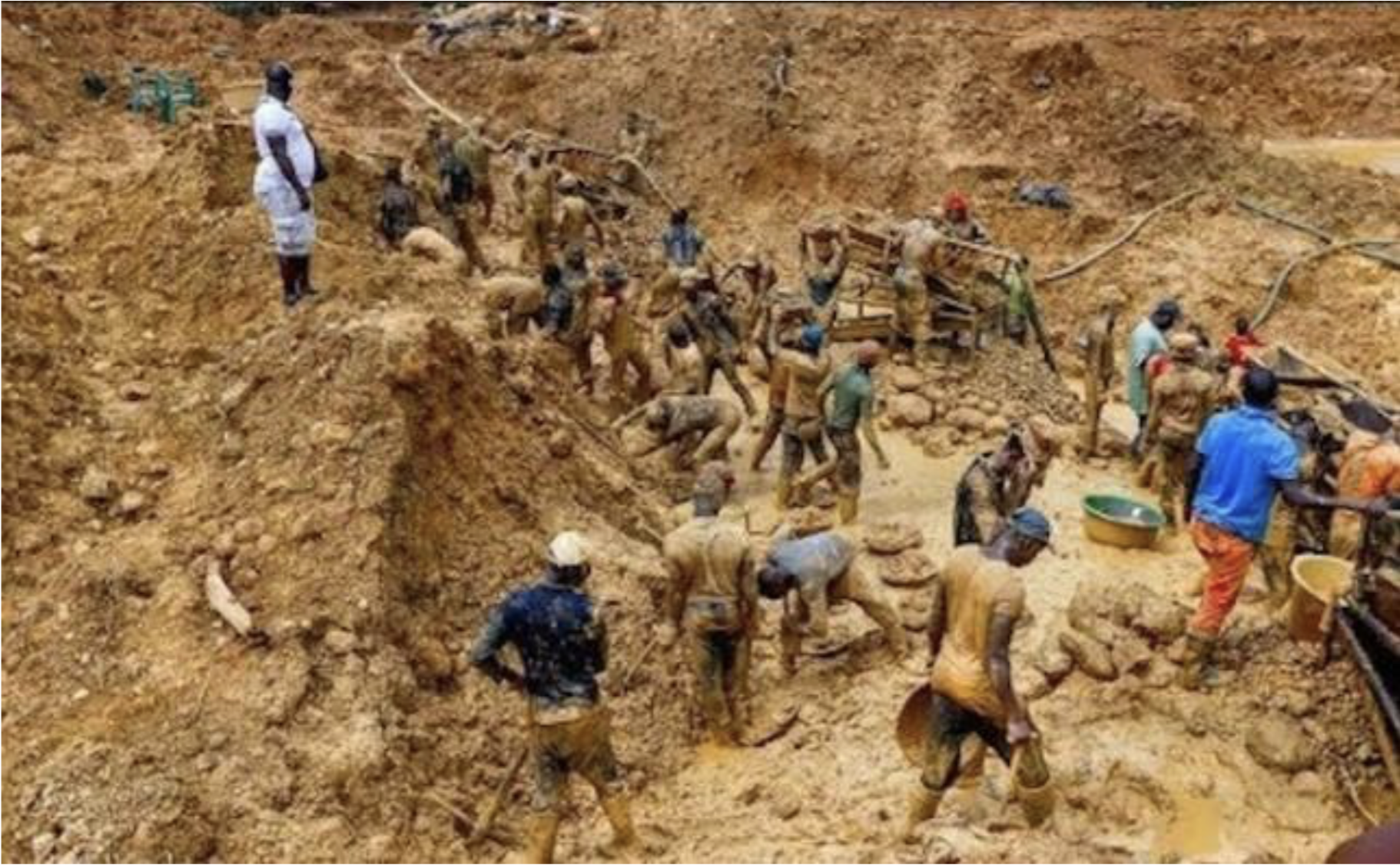
Illegal mining in Nigeria. Photo: Global Initiative Against Transnational Organized Crime

This is exactly what Bookchin meant:
Environmental wounds are almost always social wounds first.
Towards a Different Way of Seeing the Crisis
Drawing upon the landmark Scenic Hudson Preservation Conference v. Federal Power Commission (Storm King Mountain) case, the case examines how legal recognition of citizens’ right to protect the environment reflects an evolution of Lockean ideals into environmental jurisprudence. The case, argued by Paul, Weiss, Rifkind, Wharton & Garrison LLP, revolutionized environmental law by establishing the legal standing of citizens to defend aesthetic and ecological interests, thereby transforming notions of the “commons” into enforceable rights. This judicial recognition of environmental protection as a public interest hinges on redefining the boundaries of property, rights, and justice, aligning law with moral imperatives, especially as it relates to the environment.
Notably, while the Scenic Hudson case exemplifies a legal system that empowers citizens to challenge environmental harm, Nigeria presents a starkly different reality. As evidenced, despite widespread illegal mining and extensive ecological degradation, the legal and institutional frameworks rarely grant affected communities the standing—or even the access—to challenge these violations. This clear contrast exposes a critical gap: where environmental protection in the U.S. evolved into a recognized public interest enforceable by citizens, Nigerian communities remain largely excluded from such legal empowerment. Strengthening citizens’ environmental rights may be essential to addressing the escalating crisis of illegal mining in Nigeria.
Hence, if we continually approach illegal mining only from the angle of environmental enforcement, we will keep running in circles. Yes, arrests matter. Yes, shutting down illegal sites is important. But these actions don’t reach the root, and as such, have not been tackled thoroughly.
A deeper solution starts with rebuilding the relationship between communities and the land that sustains them. It means strengthening institutions in a way that ordinary people can trust. It means ensuring that local voices hold power, not only when the damage is done, but before it begins.
It means giving people enough economic stability to stop seeing risky mining jobs as their only way out.
Above all, it means recognizing that environmental healing cannot happen without social healing.
A Mirror We Must Not Look Away From
Nigeria is standing before a mirror, and that mirror is the land itself.
The mining crisis, with all its noise and shadows, is showing us what Bookchin warned the world about decades ago: a society that turns away from fairness, accountability, and community will eventually find its environment turning against it.
If we want our rivers to run clean again, our forests to breathe, and our lands to recover, we must first repair the social conditions that allowed exploitation to bloom so freely.
Environmental change begins with social change.
And at this moment, Nigeria has a chance (perhaps a rare one) to rewrite the story.
Works Cited:
https://www.arise.tv/chinese-miners-/appellate-courts/F2/453/463/386144/?utm
https://law.justia.com/cases/federal/appellate-courts/F2/453/463/386144/?utm
https://sdg.iisd.org/news/unep-releases-results-and-recommendations-of-ogoniland-oil-assessment/
Bookchin, M. (1996) The Philosophy of Social Ecology. Second Edition. Available at: https://theanarchistlibrary.org/library/murray-bookchin-the-philosophy-of-social-ecology (Accessed: January 10, 2026).
Written by Friday Praise