
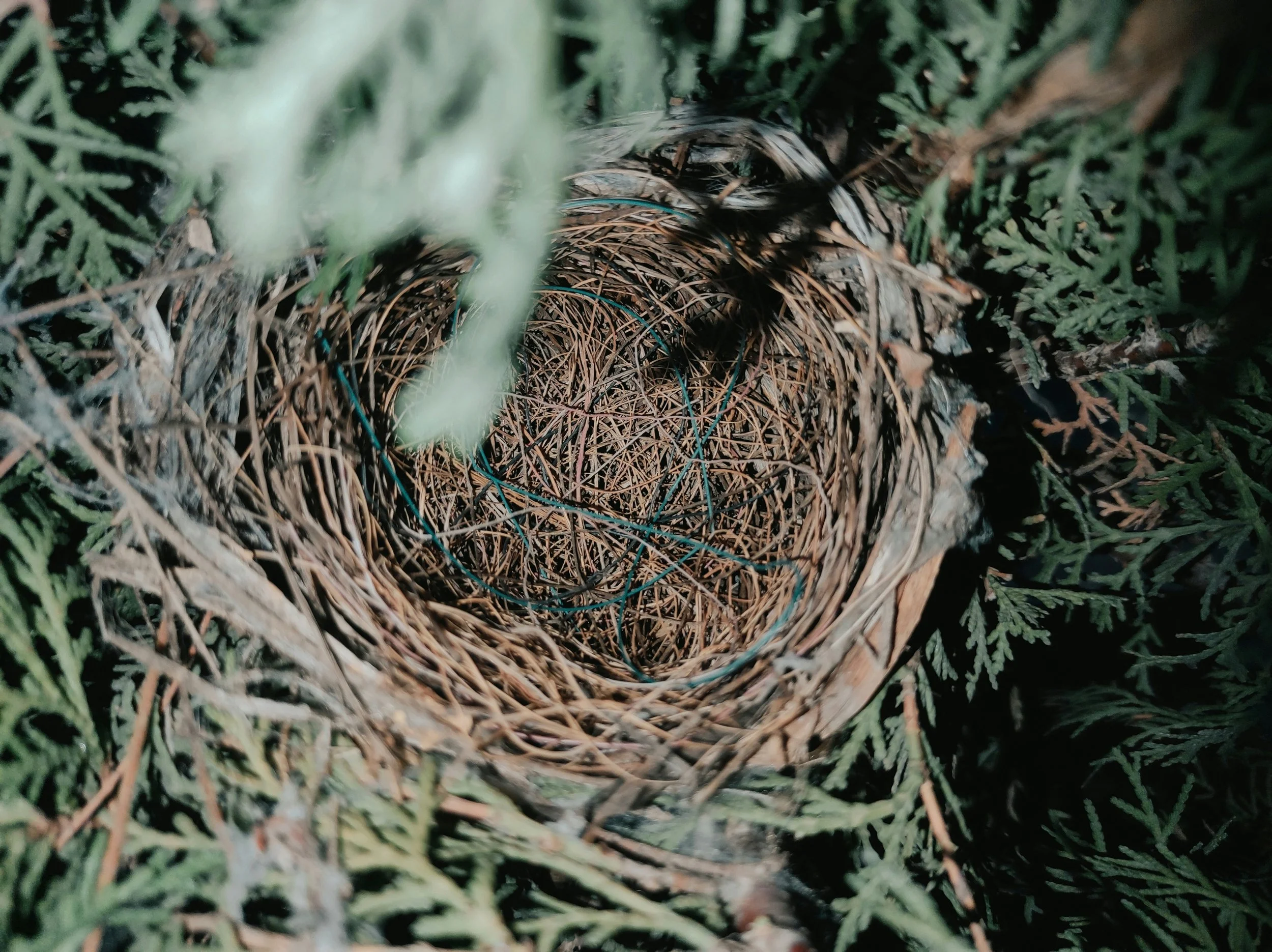
Image showing a bird’s nest, containing wires.
Written by Arisia
Deep inside the forests of Ukraine,
A bird builds her nest from scratch.
Everything carried by her beak
Makes it to her quiet home.
Twigs, branches, and fallen leaves
Gather in the quiet woods.
When she sees a piece of cable,
That once guided an attack
She does not see a weapon there.
Today, that tethered drone wire
Is woven quietly,
Into the safety of her home.
The war did not end in that clearing;
It simply changed its silent shape.
Long after headlines fade away,
It steeps where it was never meant:
In a field, a forest, and a nest.
We measure war in casualties.
We count the treaties and the lands,
Gained or lost upon a map.
We never count the groundwater,
Or birds that build from battle scraps,
Or tree lines that will not return
In this generation or the next.
Environmental costs find no place
Within the treaties that are signed.
It is not even named most times.
Settling slowly in the landscape,
Like grief that settles in a home
After a member dies.
The drone respects no borders drawn,
The smoke does not ask about one's caste,
The fallout seeks no passport check,
The displaced ecosystems do not stay
where they were displaced.
The nest remains a quiet proof
That choices carry heavy weight
Far beyond what leaders plan.
We speak of war and climate change
As parallel lines that never meet
A war fought today is also fought
Against tomorrow's climate stability
Against forests that could absorb carbon
Against soil that could feed us all
Leaving the earth to build its future
Out of what the battlefield left behind.
Every war fought on this earth,
Among everything else,
Is an environmental choice.
We simply fail to name it so,
While the battle is underway.
In Vietnam, Agent Orange settled
Deep inside the milk of mothers.
Gaza carries weight of rubble
That will take long years to clear.
Ukraine’s fibre-optic nests
Are latest lines in the endless horizon.
Each war adds its lingering mark
For peace, once declared, rarely means
That the destruction has ceased.
To recognise this wound of the earth
Is no distraction from the human loss
It is an admission they bleed as one.
The question is not if we can
Prevent the wars of human history.
The question is if we will reduce
The woven nest of optic line
To one more headline passing by,
Or treat it as the evidence.
Evidence,
That no war stays contained
Within the borders where it raged;
Evidence,
That the planet keeps every receipt,
Even all the bitter ones
We would rather never read.
Postscript: In regions across Ukraine, researchers documented birds weaving nests from discarded fibre-optic drone cables used by military forces. These war remnants offer a striking artifact of how modern warfare invades and alters ecosystems. Decades after active fighting ends, lingering military hazards from Agent Orange contaminating Vietnam's food chain to unexploded landmines in Cambodia and Bosnia, destroy vital carbon sinks and prevent environmental recovery.
The ecological damage caused by modern conflict extends far beyond immediate battlefields.
Currently, only 11 nations are completely free from internal and external armed conflict. According to recent findings, global military activities account for roughly 5.5% of total greenhouse gas emissions annually, despite when 90% GHG emissions of military conflict remains accountable. We live in an era consumed by conflict, but its ecological toll often remains an afterthought. This piece aims to bring that to the forefront. Before we can mend any of these damages, we must at least begin by acknowledging it.