
I grew up in South Africa listening to the same seasonal wisdom passed down through generations. People spoke about the promise of summer rains, the restless August winds, and the subtle signs that told farmers when the soil was waking up or winding down. These patterns shaped how communities planted, harvested and survived. My grandmother could look at the sky and confidently predict rain. She knew the right time to plant spinach long before there were planting calendars or farming apps. For decades, those signals worked.
When I started farming in open fields in Boksburg, Johannesburg, I relied on those same patterns. They were the foundation of my early years in agriculture. I planted spinach every March, following the long established Gauteng growing rhythm, which encourages sowing spinach and Swiss chard near the end of summer to prepare for a stable winter harvest[1]. I expected to harvest by June, just as previous generations had done.
However, that rhythm changed its tune.
In 2020, a frost arrived weeks earlier than expected. Overnight, the spinach leaves wilted, collapsed, and turned black at the edges. I remember stepping into the field the next morning and feeling the crunch of frozen soil beneath my boots. That single frost event delayed my spinach harvest and with it the market window that supported my income.
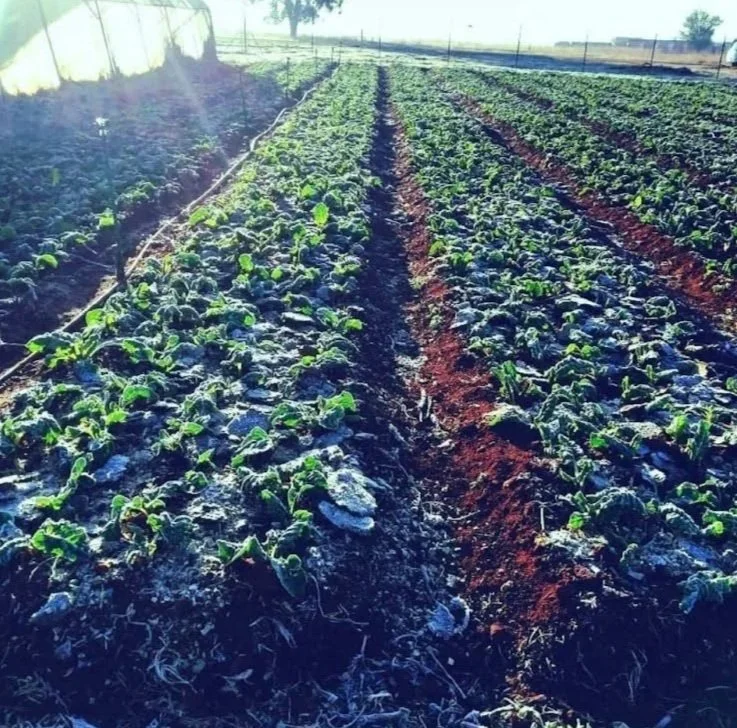
Image taken by author, Gugulethu Mahlangu, 2020
This was not an isolated event. South Africa has been warming [2] at twice the global average. The country has seen clear shifts in seasonal patterns, greater frequency of extreme weather events and growing inconsistency in rainfall. [2] Between 2020 and the present, heatwaves, unseasonal frosts and sudden flooding events have increased across the provinces. Even the growing window for our staple: maize (which is typically planted in spring and harvested in the summer rains) has become less dependable, with onset of rains and cessation dates shifting in major maize provinces. [3] Studies suggest that maize yields could decline by 8-21 % under increased heat and drought stress[4], underscoring how much tighter the planting-and-harvest margin has become for staple crops. So there it is, all we rain fed farmers, are among the most vulnerable.
When I later moved to Makhanda in the Eastern Cape, the reality of climate variability became even more evident. The climate in this area is influenced by maritime winds, coastal moisture and complex micro weather systems. One day may bring mist and drizzle while the next feels intensely hot. Farming advice in Makhanda cannot rely on memory or inherited wisdom. I realised that if I wanted to farm consistently and build a sustainable business, I needed a production system that no longer depended on rainfall patterns that no longer occur in predictable ways.
Science confirmed what I was experiencing. Research shows that in South Africa, average temperatures may rise by up to 3.5 degrees Celsius by 2060, resulting in increased evaporation, heat stress, and extreme rainfall events.[2] Yields of rain fed crops are expected to decline in many regions because higher temperatures speed up evapotranspiration and disrupt normal crop development [5]. Agriculture already uses more than 60% of the country’s water resources, and climate models indicate that irrigation demand will rise significantly as the climate becomes hotter [5]. These changes have direct consequences for smallholder farmers who cannot absorb the financial impact of unpredictable harvest cycles.
At the heart of these disruptions lies the fossil fuel industry. Although climate change is a natural process over long periods of time, the rapid warming we are experiencing today is primarily driven by human greenhouse gas emissions from coal, oil and gas[6]. South Africa’s heavy reliance on coal, which provides more than 80 percent of the country’s electricity, makes it one of the highest per capita emitters on the continent. I have experienced this firsthand because I was born and bred in Emalahleni, a town defined by coal mines and power stations, where the environmental cost of fossil fuels is part of everyday life. Seasons behave differently there, the polluted air carries the weight of industrial activity and climate change does not feel abstract. It feels personal.
Living through these contradictions eventually shaped the way I approached farming. I did not simply wake up one morning and decide to adopt aquaponics. The truth is that aquaponics found me long before I understood what it really was. Aquaponics came into my life through a complete accident. I was working on a conventional spinach farm in Boksburg when a media company filmed us and uploaded the video to YouTube [7]. They mistakenly labelled the farm as an aquaponics operation, and German investors who were scouting for aquaponics farmers found it. That simple error became the doorway into an entirely new direction for my farming journey.. At first it was curiosity, then research, and then the realisation that this system answered questions I had been asking silently for years. How do you farm in a world where the rains no longer keep their promises? How do you stay in agriculture when the climate is rewriting the rules faster than farmers can adapt?
That experience changed the direction of my work. After working at a commercial aquaponics farm and realising how it answered the challenges I was facing with climate instability, I shifted my business from conventional spinach farming to aquaponics. It felt like the natural next step, especially at a time when climate losses were becoming impossible to ignore. We have lost reliable seasons, crops, and even parts of our health in towns like the one I grew up in, where mining and pollution have shaped daily life, and aquaponics gave me a way to move forward with a kind of agriculture that still feels possible.
Aquaponics integrates fish, plants and beneficial microorganisms within a closed loop system. This allows me to create a stable microclimate regardless of external temperatures. Water temperature, nutrient levels and oxygenation remain consistent even when the Eastern Cape shifts from misty mornings to hot afternoons. My crops receive water continually through the recirculating system rather than relying on unpredictable rainfall. Instead of losing produce to frost or heatwaves, I can harvest throughout the year.
Aquaponics also aligns with my values. It saves water, reduces the need for chemical inputs, and supports community resilience. In a country where drought frequently affects rural economies, aquaponics uses up to 90 percent less water than traditional farming. In regions where young people often lack access to land, aquaponics allows high productivity in small spaces.
What surprised me most was how aquaponics restored my confidence. It allowed me to plan again. I could commit to supplying restaurants, households and community partners without constantly worrying about sudden weather changes. Aquaponics returned predictability to a world that had become uncertain.
I do not see aquaponics as a replacement for open field agriculture. Instead, I see it as one of the climate smart tools African farmers can use to navigate an increasingly unstable climate. The land taught me everything I know and I honour those who continue to work in open fields despite the challenges. However, for me and for many young farmers, the future must include systems that protect us from climate shocks we did not intentionally create. We may not be able to return the August winds to their old rhythm or restore the reliability of the summer rains, but we can build farming systems that reflect the world as it is today and prepare us for the world that is coming.
Written by Gugulethu Mahlangu
References:
[1] Builders Warehouse. n.d. Vegetable Calendar: What to Plant Each Month. Available at: https://blog.builders.co.za/vegetable-calendar-what-to-plant-each-month/ (Accessed: 22 November 2025).
[2] ACBIO (African Centre for Biodiversity). 2023. The Impacts of Climate Change on Small-Scale Farmers in South Africa. Available at: https://acbio.org.za/wp-content/uploads/2023/09/FactS-04-ENG-Impacts-of-CC_WEB_fin.pdf (Accessed: 22 November 2025).
[3] Matimolane, M., Musyoki, A., du Preez, K., van der Merwe, C., & Hlazo, L. 2023. Climate change impacts on crop production in South Africa: A review. Journal of Environmental Science and Policy, 152, pp. 12–25.
[4] Vogel, C., Nhemachena, C. and Thomas, T. 2024. Heat stress and drought impacts on maize production in Southern Africa. Agriculture and Climate Dynamics, 18(2), pp. 45–59.
[5] UNU-WIDER. 2020. Climate change, irrigation demand, and crop yields in South Africa. United Nations University World Institute for Development Economics Research. Available at: https://www.wider.unu.edu/publication/climate-change-effects-irrigation-demand-and-crop-yields-south-africa (Accessed: 22 November 2025).
[6] IPCC. 2021. Sixth Assessment Report (AR6). Intergovernmental Panel on Climate Change. Available at: https://www.ipcc.ch/assessment-report/ar6/ (Accessed: 22 November 2025).
[7] YouTube. 2018. Aquaponic system [Video]. Available at: https://www.youtube.com/watch?v=QMw3-y0A2Vs (Accessed: 22 November 2025).
[8] Mahlangu, G. 2020. Spinach crop in Boksburg before early frost [Photograph]. Instagram. Available at: https://www.instagram.com/p/CBaEllDlJBf/?igsh=MXhsbDR5MjBzdmJobw== (Accessed: 22 November 2025).